Randomites
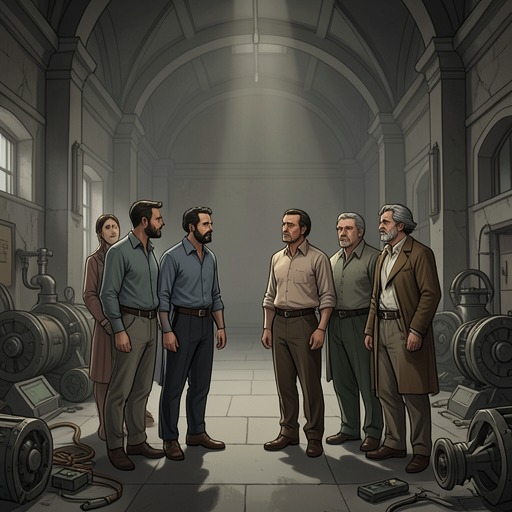
The Old AxolotlThe Randomites are a group encountered through their radical self-randomization: they alter themselves in both neural and genetic terms, shifting toward whatever form seems suitable at a given moment. Their brief appearance frames identity as something they can repeatedly remake, rather than a fixed basis for collective life.
Identity and Appearance
The available evidence identifies the Randomites as a group on the Canaries. Their name also appears in a roster alongside First Paradise, Eternal Empire of the Hans, Salamanders, MIT, and other named groups or institutions. The roster establishes their place among the book’s wider array of collectives, but does not specify their membership, leadership, or formal structure.
Self-Randomization
Dagenskyoll describes the Randomites as people who randomize themselves in their neural and DNA systems. Their choices are variable: sometimes one configuration suits them, sometimes another. The account presents this not as an accidental instability imposed from outside, but as something they actively do to themselves. It offers no single settled description of what they become; continual variation is the point.
The Matternet and Negotiation
Bartek asks whether the Randomites on the Canaries uprooted their Matternet. Dagenskyoll confirms the report, placing their self-alteration alongside a consequential break with a networked material system. The evidence does not explain how the uprooting was organized or what followed, but it makes clear that the group’s relationship to network infrastructure is not simply one of passive dependence.
Dagenskyoll recalls spending a week negotiating with them and says the experience nearly drove him to madness. The anecdote conveys the practical difficulty of dealing with a group whose members may change their neural and genetic configurations according to what suits them. By contrast, he says that seeing Bartek feels like returning to his senses. The Randomites thus enter the conversation as a sharp point of contrast: not a stable political model described in detail, but a group whose deliberate variability makes negotiation exhausting and whose collective relation to the Matternet has been disrupted.